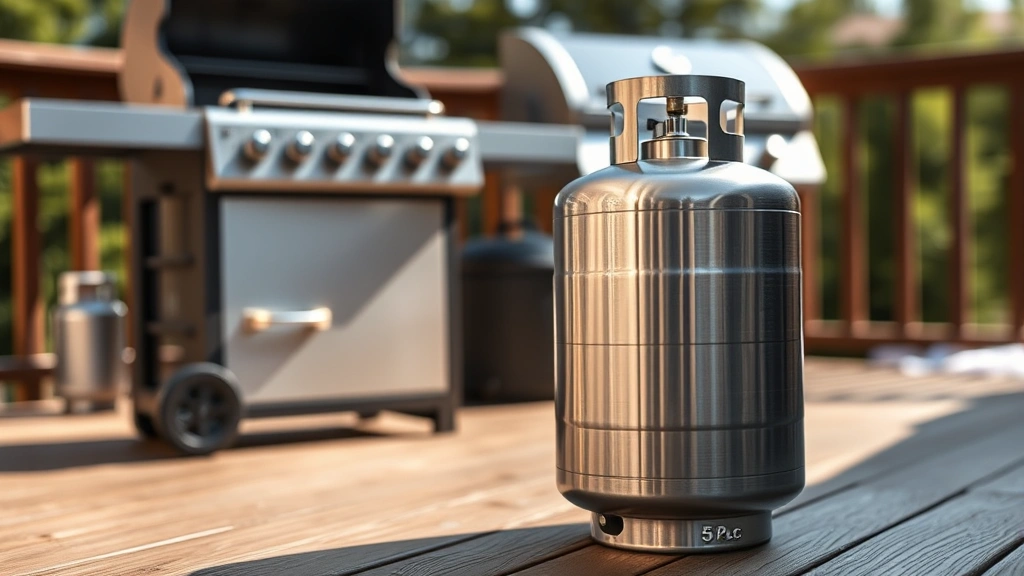
Refill or Exchange? 5lb LP Gas Tank Insights
When it comes to propane management, understanding your options for a 5 lb LP gas tank can significantly impact both your wallet and your environmental footprint. Whether you’re fueling a grill, camping stove, or portable heater, the decision between refilling and exchanging your tank involves considerations that extend beyond simple convenience. This comprehensive guide explores the sustainability implications, cost-benefit analysis, and practical insights to help you make informed decisions about propane tank management.
The propane industry has evolved considerably, offering consumers multiple pathways for tank maintenance. Many people don’t realize that their choice between refill and exchange programs directly affects resource consumption, transportation emissions, and overall sustainability. By understanding these options through an eco-conscious lens, you can align your propane usage with your environmental values while optimizing your spending.
Understanding 5lb LP Gas Tank: Basics and Applications
The 5 lb LP gas tank represents one of the most portable and versatile propane storage solutions available today. These compact cylinders, typically measuring around 12 inches in height and weighing approximately 10-11 pounds when full, serve countless applications across residential, recreational, and commercial settings. Understanding their specifications and common uses provides essential context for evaluating refill versus exchange options.
A full 5 lb tank contains approximately 2.5 gallons of liquid propane, delivering roughly 100,000 BTU of energy. This capacity makes them ideal for small grills, camping equipment, portable heaters, and emergency backup systems. The versatility of these tanks has made them increasingly popular among households seeking flexible energy solutions, particularly those interested in sustainable energy solutions that reduce grid dependence.
These tanks are manufactured under strict industry standards regulated by the Department of Transportation (DOT) and the Propane Code Authority. Each tank receives a certification stamp indicating its manufacturing date and next required inspection interval. Most 5 lb tanks require hydrostatic testing every 12 years, though many manufacturers recommend earlier replacement to ensure optimal safety and performance.
Refill vs. Exchange: The Core Differences
The distinction between refilling and exchanging your 5 lb LP gas tank fundamentally affects your experience, costs, and environmental impact. Understanding these two approaches is crucial for making decisions aligned with both practical needs and sustainability goals.
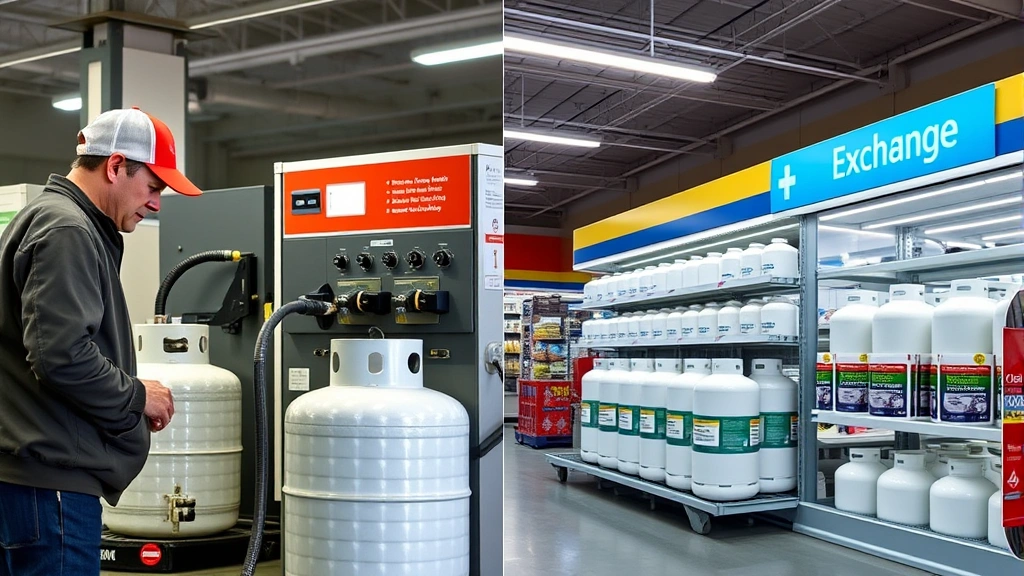
Refilling your tank involves taking your personal cylinder to a propane retailer who fills it to capacity using specialized equipment. You maintain ownership of the same tank throughout its lifespan, creating a long-term relationship with your specific container. This process typically takes 10-15 minutes and requires you to wait while the refill occurs. Refill stations are commonly found at hardware stores, fuel suppliers, and propane retailers.
Exchanging your tank follows a different model where you trade your empty or partially-filled cylinder for a pre-filled replacement from the retailer’s inventory. This swap-and-go approach prioritizes convenience, allowing you to leave with a full tank immediately without waiting. The retailer assumes responsibility for your old tank, refurbishing it for future exchanges or resale. Exchange programs are widely available at grocery stores, convenience stores, and major retailers.
From a sustainability perspective, these models create distinctly different environmental profiles. Refilling maintains tank longevity and reduces manufacturing demands, while exchange programs distribute tanks across broader consumer networks but may accelerate replacement cycles.
Cost Comparison and Long-Term Financial Impact
Financial considerations often drive tank management decisions, though the true cost picture extends beyond single-transaction pricing. Comparing refill and exchange programs reveals nuanced economic patterns that vary by region, retailer, and usage frequency.
Refill pricing typically ranges from $15-$25 per tank, depending on local propane market rates and retailer markup. Since you’re only purchasing the propane itself, costs directly correlate with commodity prices. Over a year, a household refilling one tank monthly spends approximately $180-$300 on fuel alone. This straightforward pricing model appeals to budget-conscious consumers and those with predictable usage patterns.
Exchange programs generally cost $18-$35 per tank, reflecting not only propane but also the retailer’s tank refurbishment, logistics, and inventory management. The convenience premium typically adds 20-40% to the per-unit propane cost. However, exchange customers avoid initial tank purchases and long-term maintenance responsibilities, eliminating unexpected costs associated with tank certification or replacement.
A critical financial consideration involves tank ownership and lifespan economics. When you refill, you maintain your tank indefinitely, amortizing its initial purchase cost ($30-$60) across years of use. Exchange participants effectively lease tanks through perpetual purchase agreements, never accumulating ownership equity. For heavy users, refilling becomes economically advantageous after approximately two years of regular use.
Regional variations significantly impact these calculations. Areas with competitive propane markets show narrower refill-exchange gaps, while regions with limited retailers often see exchange premiums exceed 50%. Researching local options and calculating your annual propane consumption helps determine which approach optimizes your household budget while supporting reducing your environmental footprint.
Environmental Considerations and Carbon Footprint
Sustainability analysis of tank refilling versus exchanging reveals complex environmental tradeoffs that extend beyond simple propane consumption. The manufacturing, transportation, and lifecycle impacts of these two approaches create meaningfully different carbon signatures.
Manufacturing impact dominates exchange programs. Each new tank requires raw materials extraction, steel production, and fabrication energy. When exchange programs cycle tanks every 5-7 years instead of 15-20 years through refilling, they effectively double manufacturing frequency. Steel production generates approximately 1.9 tons of CO₂ per ton of steel produced. A single 5 lb tank weighing 8 pounds empty represents roughly 14 pounds of manufacturing emissions before any propane enters it. Accelerated tank replacement through exchange programs multiplies this impact across millions of consumer transactions annually.
Transportation emissions differ substantially between approaches. Refill customers typically make individual trips to local retailers, consolidating propane purchases with other errands. Exchange customers often experience convenience-driven purchasing patterns, making additional trips specifically for tank swaps. Studies indicate exchange participants generate 30-40% more transportation-related emissions per unit of propane consumed due to increased trip frequency and reduced consolidation opportunities.
Propane itself remains identical regardless of refill or exchange choice. However, the infrastructure supporting each model creates distinct emission profiles. Refill networks require localized storage and distribution, while exchange programs depend on centralized warehousing and regional logistics. Centralized systems often achieve better efficiency through optimized routing and bulk handling, potentially offsetting some manufacturing disadvantages.
According to EPA guidance on propane safety and efficiency, consumers can minimize environmental impact by adopting strategic tank management practices. Consolidating multiple small tanks into fewer larger containers, maintaining equipment to prevent leaks, and choosing refilling for regular consumption patterns all contribute to reduced carbon footprints.
The lifecycle assessment perspective suggests refilling aligns better with circular economy principles promoted by Union of Concerned Scientists and other environmental organizations. Extending product lifespan through maintenance and refilling rather than perpetual replacement represents a fundamental sustainability principle applicable across consumer goods industries.

Safety Standards and Maintenance Requirements
Both refill and exchange approaches maintain rigorous safety standards, though they distribute maintenance responsibilities differently. Understanding these requirements ensures you make choices supporting both personal safety and environmental stewardship.
Refill tank responsibilities fall primarily on the owner. You must maintain your cylinder in safe condition, store it properly, and ensure it undergoes required inspections. Tanks manufactured after 2002 require hydrostatic testing every 12 years; older tanks need testing every 5 years. This testing, performed by certified facilities, costs $15-$25 per tank and ensures structural integrity. Neglecting testing invalidates your tank for future refills, creating an unexpected replacement burden.
Proper storage prevents corrosion, temperature damage, and safety hazards. Refill tank owners must store cylinders upright, in cool environments, away from heat sources and direct sunlight. This responsibility adds maintenance considerations that casual users might overlook. Environmental exposure—particularly in coastal regions with salt air—accelerates tank degradation and increases testing failure likelihood.
Exchange programs transfer maintenance responsibility to retailers. Professional refurbishment includes inspection, testing, and any necessary repairs before tanks re-enter circulation. This systematic approach ensures consistent safety across all exchanged tanks, eliminating variables associated with individual owner maintenance. Exchange participants never face surprise inspection failures or unexpected tank removal from service.
However, exchange model accountability concerns have emerged in some regions. The Propane Education & Research Council reports occasional instances of inadequately maintained exchange tanks entering circulation. Choosing established, reputation-conscious retailers—typically major national chains—minimizes this risk significantly. Inspecting exchanged tanks for obvious damage or corrosion provides additional consumer protection.
Safety valve operation represents another critical distinction. Refill operators perform detailed safety checks before pressurizing your tank, catching valve malfunctions before they create hazards. Exchange tanks undergo similar checks at distribution centers, but the time lag between inspection and consumer use creates minimal additional risk windows. Both approaches maintain excellent safety records when participants follow recommended protocols.
Making the Right Choice for Your Needs
Determining whether refilling or exchanging serves your situation best requires honest assessment of usage patterns, lifestyle priorities, and values. No universal answer exists; the optimal choice depends on individual circumstances and preferences.
Choose refilling if you: Use propane regularly and predictably, have convenient access to local refill stations, value long-term cost savings, prefer maintaining your own equipment, and prioritize minimizing manufacturing waste. Refilling works exceptionally well for households with permanent grills, regular camping trips, or backup heating systems. Regular users typically see refilling costs drop 30-40% below exchange pricing over multi-year periods.
Choose exchanging if you: Prefer maximum convenience, use propane sporadically or unpredictably, lack storage space for tank maintenance, value zero responsibility for tank maintenance, or live in areas where refill options are limited. Exchange programs excel for occasional users, renters, or those with mobility constraints. The premium cost becomes negligible when divided across infrequent usage.
A hybrid approach often optimizes outcomes. Many households maintain one refill tank for primary applications while keeping exchange tanks available for emergency situations or travel. This strategy captures refill economy benefits while preserving exchange convenience when needed. Exploring alternative sustainable energy solutions alongside propane usage can further reduce overall energy consumption and environmental impact.
Regional factors significantly influence decision-making. Areas with abundant refill infrastructure and competitive propane markets strongly favor refilling. Conversely, rural regions with limited refill access or urban areas where car trips are inefficient may make exchange programs more practical despite higher per-unit costs.
Sustainability Tips for Propane Users
Regardless of your refill-versus-exchange choice, numerous strategies optimize propane usage and minimize environmental impact. These practices complement your tank management decisions and amplify overall sustainability benefits.
Maximize efficiency through equipment maintenance. Clean grill grates, maintain burner alignment, and inspect connections regularly. Well-maintained equipment converts propane to usable energy more effectively, reducing consumption per cooking session or heating cycle. Annual professional inspections catch leaks before they waste resources and create safety hazards.
Consolidate tank sizes strategically. Using larger tanks for primary applications reduces manufacturing frequency compared to multiple small tanks serving identical purposes. A single 20 lb tank used regularly generates lower lifecycle emissions than four 5 lb tanks rotating through similar applications. However, maintaining green technology innovations like efficient portable equipment still offers sustainability value for mobile applications.
Store tanks properly to extend lifespan. Protecting cylinders from weather extremes, salt air, and temperature fluctuations prevents premature degradation. Covered storage areas, periodic cleaning, and protective coatings significantly extend serviceable tank life, reducing replacement frequency and associated manufacturing emissions.
Monitor consumption patterns. Tracking propane usage helps identify efficiency opportunities and prevents waste. Households often discover unexpected leaks, inefficient appliances, or behavioral changes through consumption monitoring. This awareness enables targeted interventions that reduce environmental impact and lower costs simultaneously.
Explore propane alternatives for appropriate applications. Electric grills, solar heaters, and rechargeable heating devices increasingly offer viable alternatives for certain uses. Evaluating whether particular applications truly require propane or could transition to renewable alternatives represents a meaningful sustainability practice. Advantages of electric vehicles extend beyond transportation; electric alternatives across home and recreational applications reduce fossil fuel dependence.
Support responsible propane retailers. Choosing suppliers who prioritize sustainability, maintain rigorous safety standards, and implement carbon-reduction initiatives amplifies your environmental impact. Many progressive propane companies now offer carbon offset programs, renewable propane blends, and equipment efficiency consulting services.
FAQ
How long does a 5 lb propane tank last?
A full 5 lb tank’s duration depends entirely on usage. Typical grilling uses approximately 1-2 pounds per session, suggesting 3-5 cooking sessions per tank. For heating applications, consumption varies dramatically with temperature, equipment efficiency, and usage duration. A small patio heater might run 20-30 hours on a full tank, while a larger heater consumes fuel much faster. Tracking your specific consumption patterns provides accurate duration estimates.
Can I refill an exchanged tank?
Technically, yes—exchanged tanks remain functional propane containers. However, practical barriers often prevent this. Exchange tanks typically don’t include ownership documentation, making refill stations reluctant to fill them due to liability concerns. Some retailers specifically mark exchange tanks, preventing refill station acceptance. If you possess an exchange tank you wish to refill, contact local retailers about their policies; some will accommodate requests with proper documentation.
What’s the environmental impact of propane versus natural gas?
Propane and natural gas share similar combustion emissions, both producing carbon dioxide and water vapor. The environmental distinction lies in sourcing and distribution. Natural gas typically requires pipeline infrastructure with associated land disruption and methane leakage concerns. Propane’s portable tank model eliminates pipeline infrastructure but requires manufacturing and transportation. For portable applications where natural gas pipelines don’t exist, propane represents the more practical option, though neither qualifies as truly sustainable compared to renewable alternatives.
How often should I inspect my refill tank?
Visual inspections should occur before each use, checking for visible damage, corrosion, or leaks. Professional hydrostatic testing is required every 12 years for tanks manufactured after 2002, and every 5 years for older models. Many propane retailers recommend inspection intervals as short as every 5-7 years for optimal safety, particularly in harsh storage environments. Regular inspection prevents safety issues and ensures your tank remains eligible for refills.
Are exchange tanks newer than refill tanks?
Not necessarily. Exchange tanks enter circulation through various pathways—some are newly manufactured, while others are refurbished older tanks. The exchange model doesn’t guarantee newer equipment; it guarantees professional maintenance regardless of tank age. Refill tanks vary similarly, depending on individual purchase timing and maintenance quality. Both systems include older and newer tanks; the key difference is maintenance responsibility and oversight rather than age.
Can I use a refill tank for exchange and vice versa?
Yes, physically the tanks are interchangeable. However, practical barriers exist. Retailers typically don’t accept unmarked tanks for exchange programs due to liability and tracking concerns. Conversely, refill stations generally accept any properly maintained cylinder meeting DOT specifications. If you own a refill tank, you can exchange it at most major retailers; the reverse—using exchange tanks for refilling—encounters more resistance despite technical feasibility.
What’s the cost difference between propane and other heating fuels?
Propane pricing fluctuates with crude oil markets but typically costs $2.50-$4.00 per gallon depending on location and season. Heating oil averages $3.00-$5.00 per gallon, while natural gas costs roughly $0.10-$0.15 per therm (approximately $3.50-$5.00 per gallon equivalent). Electricity costs vary dramatically by region but typically exceed propane for heating applications. For portable applications, propane’s convenience premium justifies its costs relative to alternatives.


