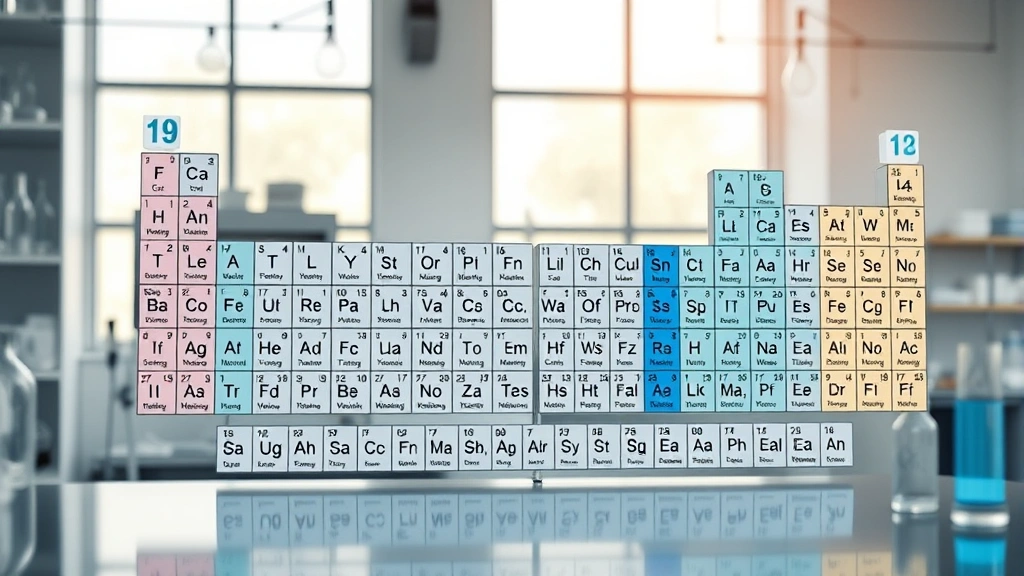
Is Uuo a Noble Gas? Scientific Facts and Understanding Synthetic Elements
Ununoctium, officially named Oganesson (Og) and temporarily designated as Uuo, represents one of the most fascinating discoveries in modern chemistry. This synthetic element occupies a unique position in the periodic table, sparking scientific debate about whether it truly qualifies as a noble gas despite its extraordinary properties. Understanding Uuo requires exploring the nature of synthetic elements, their behavior, and how they challenge our fundamental chemistry concepts.
The question of whether Uuo is a noble gas connects to broader themes of scientific discovery and sustainability. As we advance our understanding of fundamental chemistry, we develop better materials and technologies that support sustainable practices. This exploration of elemental science demonstrates humanity’s ongoing quest to understand nature, which ultimately informs our ability to create more environmentally responsible solutions.

What is Uuo? Understanding Ununoctium
Ununoctium, temporarily called Uuo before its official naming, is a synthetic chemical element with atomic number 118. It was officially named Oganesson (Og) in 2016 by the International Union of Pure and Applied Chemistry (IUPAC) to honor Russian physicist Yuri Oganessian, who contributed significantly to the discovery of superheavy elements. Uuo was first synthesized in 2002 through the collision of calcium-48 ions with a californium-249 target at the Joint Institute for Nuclear Research in Dubna, Russia.
The creation of Uuo represents a monumental achievement in nuclear physics and chemistry. Synthesizing such heavy elements requires extraordinary conditions and sophisticated laboratory equipment. These elements exist for only fractions of a second before decaying, making their study incredibly challenging. The temporary designation “Uuo” followed the systematic nomenclature for undiscovered elements, where “un-un-octium” literally means element 118, before the official name was assigned.
Understanding synthetic elements like Uuo contributes to our broader knowledge of matter and forces that govern the universe. This scientific advancement mirrors the innovation driving green technology innovations, where pushing boundaries in fundamental science enables practical applications that benefit environmental sustainability.

The Noble Gas Group Explained
Noble gases represent one of the most distinctive groups in the periodic table, characterized by their remarkable chemical inertness. This group includes helium (He), neon (Ne), argon (Ar), krypton (Kr), xenon (Xe), and radon (Rn). The defining characteristic of noble gases is their complete valence electron shells, which makes them extraordinarily stable and reluctant to form chemical bonds under normal conditions.
The noble gas group occupies Group 18 (or Group VIII in older nomenclature) of the periodic table. Each noble gas has eight valence electrons in its outermost shell, except helium, which has two. This electron configuration, known as a stable octet, represents the maximum number of electrons that can occupy the outermost orbital in most atoms. The stability conferred by this configuration explains why noble gases rarely participate in chemical reactions.
Noble gases possess several distinctive properties that make them invaluable in various applications. They conduct electricity in discharge tubes, producing characteristic colored glows—neon produces red, argon produces blue-violet, and xenon produces blue. These elements are used extensively in lighting, welding, diving gas mixtures, and as inert atmospheres in industrial processes. Their chemical inertness makes them perfect for applications requiring non-reactive environments.
The SustainWise Hub Blog explores various scientific and environmental topics that help readers understand the interconnected nature of chemistry and sustainability. Noble gases themselves play important roles in modern sustainable technologies, from efficient lighting solutions to specialized industrial processes.
Electronic Configuration and Periodic Trends
To determine whether Uuo qualifies as a noble gas, we must examine its electronic configuration. According to theoretical models and quantum mechanical calculations, oganesson (Uuo) should have the electron configuration [Rn] 5f14 6d10 7s2 7p6. This configuration appears to complete the seventh shell with eight valence electrons, theoretically matching the pattern of traditional noble gases.
However, the theoretical prediction of Uuo’s properties becomes complicated by relativistic effects—phenomena that become increasingly important as atomic number increases. At such high atomic numbers, electrons move at significant fractions of the speed of light, and Einstein’s theory of relativity becomes essential for accurate predictions. These relativistic effects cause significant deviations from the simple periodic table patterns observed in lighter elements.
Periodic trends in the periodic table generally show that properties change gradually as you move across periods or down groups. Atomic radius increases down a group, ionization energy decreases, and electronegativity decreases. However, these trends break down for superheavy elements where relativistic effects dominate. Calculations suggest that Uuo might not behave exactly like lighter noble gases, potentially exhibiting some reactivity under certain conditions.
Understanding electronic configuration connects to broader scientific literacy that supports informed decision-making about sustainable energy solutions. As we develop new materials and technologies, fundamental chemistry knowledge enables engineers and scientists to create more efficient and environmentally responsible innovations.
Why Uuo Presents Classification Challenges
The classification of Uuo as a noble gas presents several significant scientific challenges that modern chemistry must address. The primary difficulty stems from the fact that Uuo exists only in trace quantities for extremely brief periods. Creating even a few atoms of Uuo requires massive particle accelerators and sophisticated detection equipment. This makes direct experimental observation of its chemical properties virtually impossible with current technology.
Theoretical predictions suggest that while Uuo should complete the p-orbital of the seventh shell, making it theoretically a noble gas, relativistic effects might confer unexpected chemical properties. Some theoretical models propose that Uuo could potentially form chemical compounds, which would contradict the defining characteristic of noble gases—their extreme chemical inertness. This possibility challenges our classical understanding of how the periodic table works for superheavy elements.
The expanded periodic table, which includes all 118 known elements, raises fundamental questions about element classification. Superheavy elements exist in a realm where quantum mechanics and relativity intertwine in complex ways. The behavior of these elements cannot be predicted using the simple rules that work for lighter elements. Scientists must employ advanced computational chemistry and quantum mechanical models to make predictions about their properties.
Another challenge involves the definition of noble gases itself. The traditional definition relies on chemical inertness and filled valence shells. However, as we’ve learned more about chemistry, even traditional noble gases like xenon and radon can form compounds under extreme conditions. This suggests that “noble gas” might be better understood as a category describing elements that are predominantly inert rather than absolutely inert under all possible conditions.
Relativistic Effects in Superheavy Elements
Relativistic effects represent the most crucial factor determining whether Uuo behaves like a true noble gas. According to Einstein’s special theory of relativity, as electrons move at higher velocities (which occurs in atoms with high atomic numbers), their mass effectively increases. This relativistic mass increase affects orbital energies and electron behavior in ways that classical quantum mechanics cannot predict.
In lighter noble gases like xenon, relativistic effects are minimal—perhaps a few percent correction to calculated properties. However, in Uuo with atomic number 118, relativistic effects become dominant, potentially changing properties by 50% or more. The innermost electrons, particularly the s-orbital electrons, experience the strongest relativistic effects because they orbit closest to the nucleus and move at the highest velocities.
These relativistic effects cause orbital energy levels to shift in unexpected ways. The 7p electrons in Uuo might experience different shielding effects than predicted by non-relativistic quantum mechanics. Some theoretical calculations suggest that the 7p orbital might be destabilized, potentially making Uuo more reactive than expected for a noble gas. This would represent a remarkable deviation from periodic table predictions.
The study of relativistic effects in superheavy elements represents cutting-edge theoretical chemistry. Scientists use sophisticated computational methods and supercomputers to model these effects accurately. Understanding these phenomena contributes to fundamental physics knowledge and might eventually enable development of new materials with extraordinary properties, supporting the advantages of electric vehicles and other sustainable technologies through advanced materials science.
Current Scientific Consensus
The current scientific consensus, as represented by the International Union of Pure and Applied Chemistry (IUPAC) and major chemistry textbooks, classifies Oganesson (Uuo) as a noble gas. It occupies Group 18 of the periodic table, positioned below radon as the eighth and heaviest noble gas. This classification reflects its theoretical electronic configuration with a complete valence shell.
However, this classification comes with important caveats acknowledged by the scientific community. Many theoretical chemists recognize that Uuo’s actual properties might deviate significantly from those of lighter noble gases. Some research suggests that Uuo might exhibit semi-metallic properties or even form compounds more readily than traditional noble gases. These possibilities remain largely theoretical until experimental evidence becomes available.
The International Union of Pure and Applied Chemistry maintains rigorous standards for element naming and classification. Their decision to classify Uuo as a noble gas reflects the weight of theoretical evidence, even while acknowledging remaining uncertainties. This approach balances scientific evidence with the practical need for clear classification systems.
Recent theoretical studies published in peer-reviewed chemistry journals continue to explore Uuo’s properties. Researchers from institutions worldwide employ advanced computational chemistry techniques to predict how Uuo might behave. While some calculations suggest it might be slightly reactive, the consensus remains that Uuo should be classified as a noble gas based on its electronic configuration, though with the understanding that this classification might require refinement as knowledge advances.
Implications for Future Research
The classification of Uuo as a noble gas has important implications for future chemistry research and education. It demonstrates that the periodic table remains a living framework that evolves as scientific understanding deepens. The inclusion of synthetic superheavy elements challenges chemists to refine their theoretical models and develop better predictive tools for understanding matter.
Future research into Uuo and other superheavy elements will likely employ increasingly sophisticated techniques. Advances in particle accelerator technology might eventually enable more detailed studies of Uuo’s chemical properties. Improved computational methods might provide more accurate predictions of how relativistic effects influence element behavior. These advances could revolutionize our understanding of chemistry at the extremes.
The study of synthetic elements connects to broader scientific advancement that supports how to save energy at home and other sustainability goals. Understanding fundamental chemistry enables development of better materials, more efficient processes, and innovative solutions to environmental challenges. The same scientists who study superheavy elements also contribute to developing sustainable technologies.
Education about Uuo and synthetic elements helps cultivate scientific literacy and critical thinking. Understanding that scientific classifications sometimes contain uncertainties and require refinement teaches important lessons about the nature of scientific knowledge. This perspective encourages people to approach scientific claims thoughtfully and to value evidence-based reasoning—skills essential for addressing complex challenges like climate change and environmental sustainability.
The discovery and study of Uuo exemplifies human curiosity and our drive to understand the fundamental nature of matter. While Uuo has no practical applications and exists only in laboratory conditions, the pursuit of this knowledge represents a valuable human endeavor. The technologies and insights developed through such fundamental research often find unexpected applications that benefit society and support sustainable development.
FAQ
Is Oganesson (Uuo) radioactive?
Yes, Oganesson is highly radioactive. All atoms of Oganesson are synthetic and unstable. The most stable known isotope, 294Og, has an extremely short half-life of approximately 0.89 milliseconds. This extreme instability makes it impossible to study Oganesson’s chemistry directly through traditional laboratory experiments.
How was Uuo discovered?
Oganesson was first synthesized on December 20, 2002, at the Joint Institute for Nuclear Research in Dubna, Russia. Scientists created it by bombarding a californium-249 target with calcium-48 ions. The collision produced a single atom of oganesson that was detected through its radioactive decay products. Subsequent experiments in 2005 and 2006 confirmed the discovery.
Why is it called Oganesson?
The element was officially named Oganesson (Og) in 2016 to honor Yuri Oganessian, a Russian nuclear physicist who made significant contributions to the discovery of superheavy elements. This naming convention follows IUPAC guidelines that often name elements after scientists who made important contributions to their discovery.
Could Uuo form chemical compounds?
Theoretical calculations suggest that Uuo might be capable of forming chemical compounds under extreme conditions, despite being classified as a noble gas. However, the extremely short half-life of Oganesson makes direct experimental confirmation impossible with current technology. This remains one of the most intriguing open questions in superheavy element chemistry.
How many atoms of Uuo have been created?
Scientists have created only a handful of atoms of Oganesson through particle acceleration experiments. The entire scientific knowledge of Oganesson comes from studying the decay products of these few atoms and from theoretical calculations. This limited experimental data makes Oganesson one of the least directly studied elements.
Will we ever be able to study Uuo’s chemistry directly?
Direct chemical studies of Uuo remain beyond current technological capabilities. Future advances in particle accelerator technology and detection methods might eventually enable more detailed investigations. However, the fundamental challenge of Uuo’s radioactive instability will likely always limit what can be experimentally observed about its chemical properties.
What does the future hold for superheavy element research?
Future research will likely focus on discovering additional superheavy elements beyond Oganesson and refining theoretical models of their properties. Advanced computational chemistry techniques will provide better predictions of how relativistic effects influence superheavy element behavior. This research contributes to fundamental physics and chemistry understanding while potentially enabling development of new materials and technologies.